Exponential growth
The exponential function maps the real line (from minus infinity to plus infinity) to the range zero to plus infinity in a monotonically increasing manner. It is normally encountered in modelling in the form of exponential decay to a finite number. Exponential growth, going to infinity, requires infinite resource or it comes to a sudden halt having used all available resources.
The popularity of exponential growth seems to be due to the ease with which anyone can draw a straight line on a log-plot. This is particularly dangerous when they extrapolate the curve as happened during the years of Covid-19 never minding 180 years of prior art to the contrary. People also incorrectly state it is happening when there has, instead, been an order of magnitude increase.
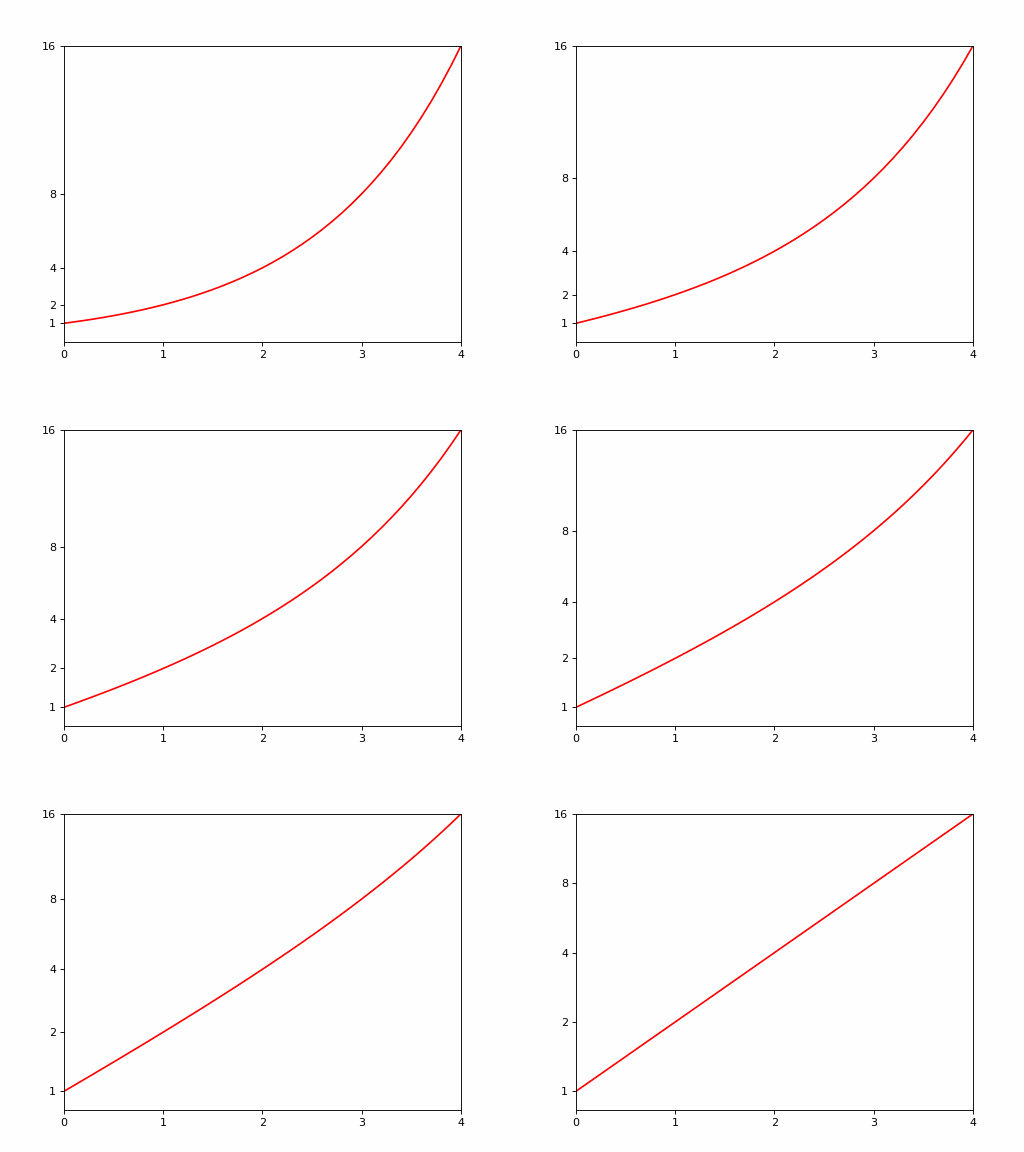
Exponential growth is usually debunked by pointing out that the variable in question is finite so a limit cannot be exceeded. Reductio ad absurdum. A more subtle argument is to ask what happens and when to cause a finite variable to leave a curve to infinity? The resulting silence then allows appeal to Occam's razor. i.e. It was never growing exponentially in the first case.
Other curves grow to infinity. e.g. The hyperbola which has the same etymological root as hyperbole but goes to infinity in finite time rather than the infinite time of the much slower exponential growth.
History
| 2400 BC | Sumerians | Compound Interest |
| 1000 AD | Persians or Indians? | Grains of wheat on a chessboard |
| 1798 AD | Malthus | Exponential population growth |
| 1840 AD | Farr | Farr's Law |
| 1859 AD | Darwin | Debunking of Malthus |
| 1910 AD | Lotka & Volterra | Lotka-Volterra predator-prey model |
| 1945 AD | Manhattan Project | Trinity Test |
| 1949 AD | Californians | Pyramid schemes |
| 1963 AD | Mandlebrot | Cotton prices |
| 1973 AD | Black, Scholes & Merton | Black-Scholes |
| 2024 AD | Mason | Minimal SIR model |